
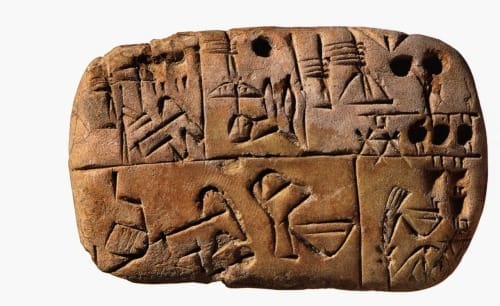
(Enmerkar’s) speech was very grand; its meaning very profound.
But the messenger’s mouth was too heavy, and he could not repeat the message. Because the messenger’s mouth was too heavy and he could not repeat it, the Lord of Kulab (Enmerkar) patted some clay and put the words on it as on a tablet. Before that day, words put on clay had never existed. But now, when the sun rose on that very day—so it was! The Lord of Kulab had put words as on a tablet—so it was!
-from Enmerkar and the Lord of Aratta, lines 500-506
circa 2100-2000 BCE
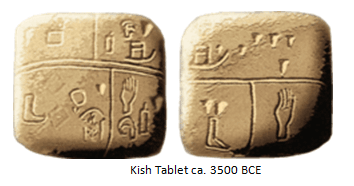
At first glance, this tablet may not seem that remarkable, but don’t be deceived. Not to be punny, but definitely don’t judge this book by its cover. There’s more than meets the eye here. The tablet pictured above is recognized as the earliest discovered example of (proto-cuneiform) writing and is known as the Kish Tablet.
Excavated by Stephen Langdon during a dig from 1923-1933, the Kish Tablet was found in a temple near the city of Kish in the city-state of Uruk, which is located in modern day Iraq. While there are older tablets, what makes this particular one different is that the glyphs here don’t represent objects as they are drawn, they represent ideas, instead. This was an entirely new use of pictorial drawings, and represents a major shift in communications. In the same way that letters and words can represent entire philosophies, ideas, and thoughts these glyphs spoke to their contemporaries in the same way. The impact reverberates down through time; if one considers this the first ‘book,’ then it is the ancestor of all that come after. Every great work of literature in print owes itself to this moment in time.
Frequently Asked Questions
What is the Kish Tablet?
The Kish Tablet is a small clay tablet recognised as the earliest known example of proto-cuneiform writing. Dated to approximately 3500 BCE, it was excavated near the ancient city of Kish in Uruk (modern-day Iraq) by Stephen Langdon between 1923 and 1933, and is now housed at the Ashmolean Museum, Oxford.What makes proto-cuneiform writing different from earlier pictographs?
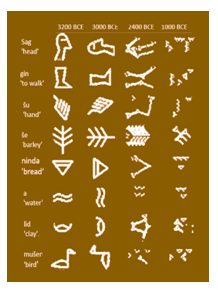
Earlier pictographs represented physical objects as drawn. Proto-cuneiform glyphs, as seen on the Kish Tablet, represent abstract ideas and concepts — not just the objects depicted. This shift from representational to conceptual notation marks a fundamental advance in human communication and the beginning of true written language.Where is the Kish Tablet now?
The Kish Tablet is held in the Ashmolean Museum at the University of Oxford, UK, where it has been on display as part of the museum’s ancient Near East collection. It remains one of the most significant artefacts in the history of written communication.Why does the Kish Tablet matter to the history of publishing?
The Kish Tablet represents the first act of recording ideas in a transmissible physical form — the fundamental concept behind all publishing. Every printed book, journal, or digital publication descends from this innovation. It is the ancestor of all written communication and, by extension, the publishing industry itself.How old is the Kish Tablet?
The Kish Tablet is estimated to be approximately 5,500 years old, dating to around 3500 BCE — placing it in the Late Uruk period of ancient Mesopotamia. This makes it the oldest discovered example of writing that uses symbols to represent abstract ideas rather than simply drawn objects.